Appearance
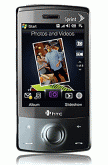
Weighing approximately 110 grams, the sophisticated steel-inspired design of the Diamond represents a sleek upgrade to the minimalist character of the first generation HTC Touch, which Sprint began carrying late last fall. The back cover features accented facets resembling a diamond, hince the name. Unlike the iPhone, which has a touch screen, or the BlackBerry, which uses a trackball, the Diamond comes with a stylus that secures in a magnetized slot on one side of the device.
Phone Components
Not only does the phone feature a good-looking handset, but it also boasts a range of components that help to drive the Diamond into Touch 2.0 territory. The touch-friendly user interface comes equipped with 3D TouchFlo technology, enabling richly animated presentations of graphics and text on a 2.8-inch, VGA resolution, LCD screen.
It has a generous 4 gigabytes of internal storage. The device also comes with a 528 megahertz Qualcomm processor, has a 3-gigabyte data capability, and features a Windows Mobile 6.1 professional platform, which includes the Microsoft Office mobile suite and Exchange e-mail support. The device is also GPS, Wi-Fi, and Bluetooth 2.0 enabled.
User Features
Aside from the Internet Explorer (IE) browser, the Diamond scores major points for supporting Opera’s 9.5 mobile browser. Opera 9.5 allows a user to not only zoom in on specific portions of Web p
Technical Downsides
Even with a stronger chip, the device has a lag time of about a second or so navigating between screens. Also, this time around, users are prevented from swapping out portable Micro-SD cards.
The battery drained much faster when the device was used both as a phone and as a music player. And when it comes to sound, with such a muscular arsenal, the Diamond’s speaker phone feature came off a bit wimpy.
Sprint is the official carrier of the HTC Touch Diamond in the U.S. The phone retails for $549.99, but with a two-year Sprint contract, it can be purchased for $249.99, after a $100.00 mail in rebate.